

Can You Protect a Pattern Idea?
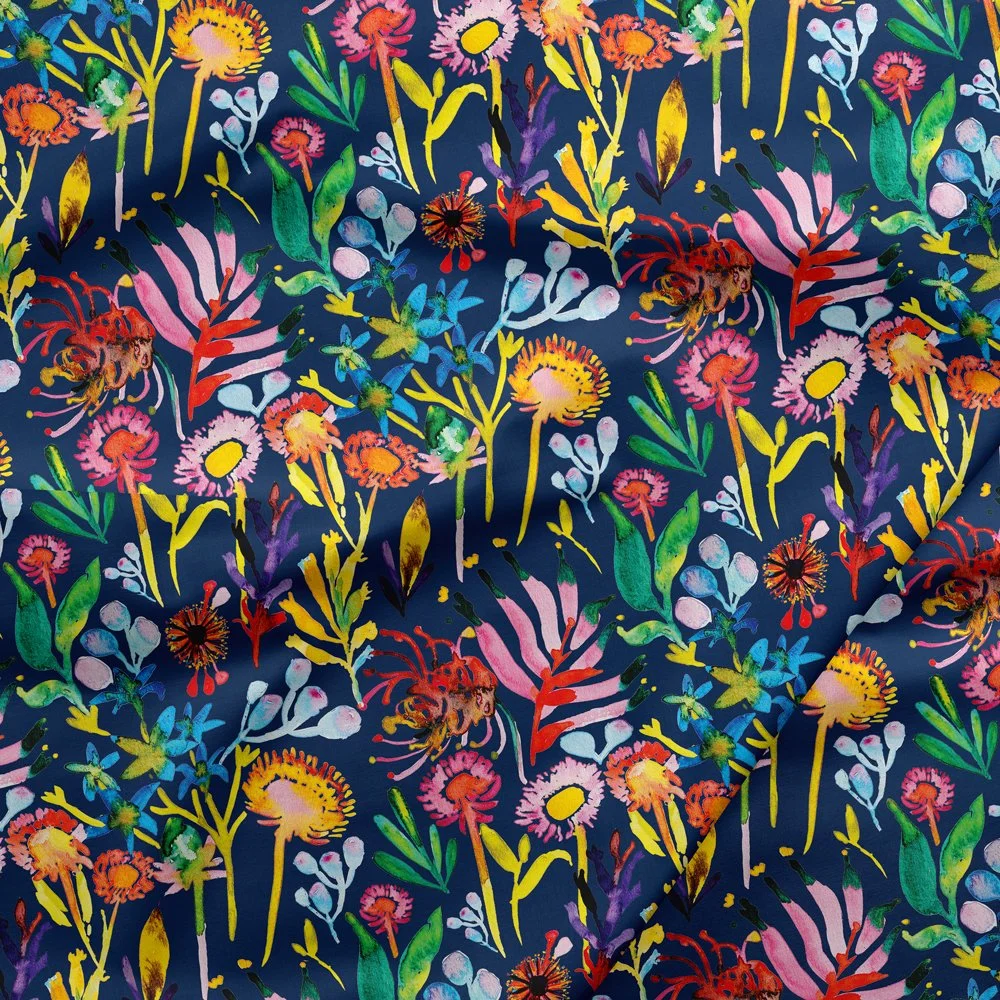
Watercolour design by Rachael King
A Guide for Surface Designers
Sometimes surface designers come up with more than just beautiful patterns.
They also come up with entirely new ways of making those patterns. You might slice fruit in half and photograph it to build a repeat. You might use unexpected stencils—everyday objects, unusual shapes, or improvised tools—to create something that feels completely fresh. Over time, these processes can start to feel like your “signature” way of working.
Naturally, that leads to a question many creatives ask: can you protect not just the final artwork, but the idea or method behind it?
Under Australian law, there is a very clear—and sometimes frustrating—distinction between the two.
Copyright, governed by the Copyright Act 1968 (Cth), protects original artistic works once they are reduced to material form. In the context of surface design, that typically includes your finished pattern file, your particular arrangement and composition, and the specific combination of colours, shapes and layout that you have created. Importantly, this protection arises automatically; there is no registration system in Australia for copyright.
However—and this is the critical point—copyright does not extend to ideas, concepts, methods or techniques.
This principle is often referred to as the “idea–expression dichotomy.” As the High Court of Australia has recognised, copyright does not protect “bare ideas” but only the particular form in which those ideas are expressed. Or, put more simply, as is often quoted in legal commentary: “There is no copyright in an idea.”
So while your particular fruit-based repeat pattern may be protected, the broader concept of “cutting fruit and turning it into a pattern” remains free for others to explore. Likewise, using stencils made from everyday objects is not something you can monopolise as a method, even if your execution of that method is distinctive.
Another way courts sometimes frame this is by asking whether what is being claimed is an idea or its expression. If it is an idea, it sits outside the scope of copyright protection. If it is a sufficiently original expression, it may be protected.
For many designers, this can feel counterintuitive. Your process might feel deeply original—perhaps even more original than the final output. But the law deliberately draws this line. As one well-known formulation puts it, copyright law is designed to “encourage creativity without unduly hindering the freedom of others to build on ideas.”
If broad methods or creative approaches could be owned, it would risk stifling innovation. Other designers would be prevented from experimenting with similar techniques, even if their outcomes were entirely different. The law instead focuses on protecting the tangible result of creativity, while leaving room for others to develop their own interpretations.
That does not mean, however, that you are without protection.
Your finished designs are likely protected by copyright. Beyond that, your business name, logo or brand identity may be registrable as a trade mark under the Trade Marks Act 1995 (Cth), giving you exclusive rights in relation to branding. In appropriate cases, the visual appearance of a product incorporating your design—its shape, configuration, pattern or ornamentation—may be eligible for protection under the Designs Act 2003 (Cth), provided it meets the requirements of newness and distinctiveness.
There are also practical, commercial tools available. Confidentiality agreements can play an important role when sharing your work with manufacturers, agents or collaborators. Well-drafted licensing agreements can clearly define how your designs may be used, and on what terms. These mechanisms do not replace intellectual property rights, but they can significantly strengthen your overall position.
It is also worth noting that while copyright protection is automatic, enforcing it is not always straightforward—particularly in industries like surface design, where trends, influences and overlaps are common. Questions of substantial reproduction, originality and independent creation can quickly become complex.
For that reason, general online guidance can only take you so far. What matters in practice is how the law applies to your specific work, your particular process, and your commercial goals.
Ultimately, understanding where the legal boundaries sit does not limit creativity—it supports it. When you know what can be protected, and what cannot, you are in a much stronger position to share your work confidently, enter into collaborations, and build a sustainable design business.
By Sharon Givoni
This article is general information only and does not constitute legal advice. Sharon Givoni Consulting can assist with tailored, practical guidance on intellectual property, including copyright, trade marks, designs, licensing and commercialisation—delivered with clarity and without the legalese. Visit our website, call us on mobile, or email info@sharongivoni.com.au.